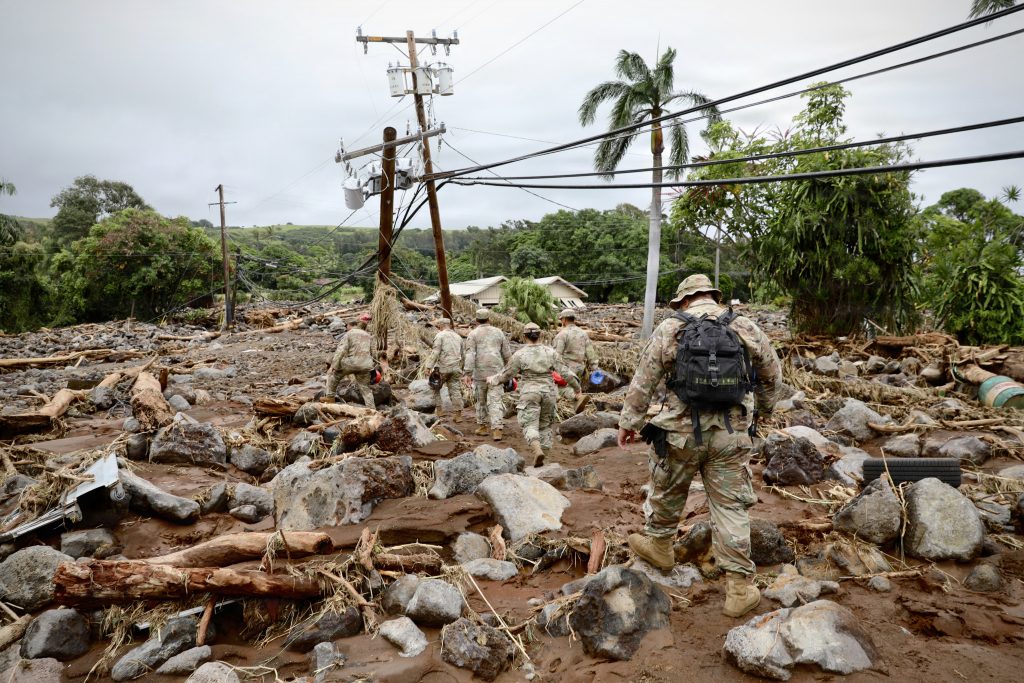
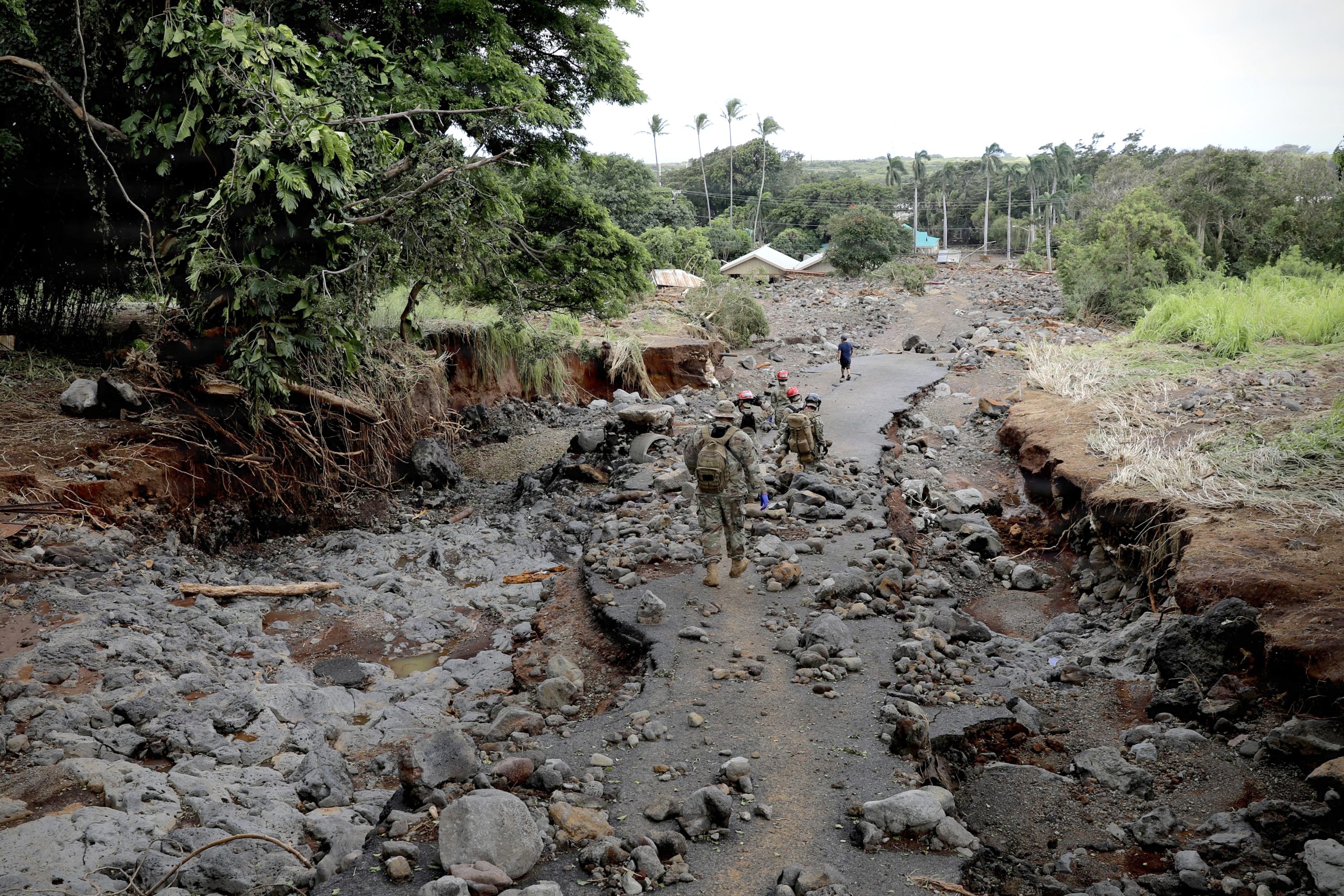
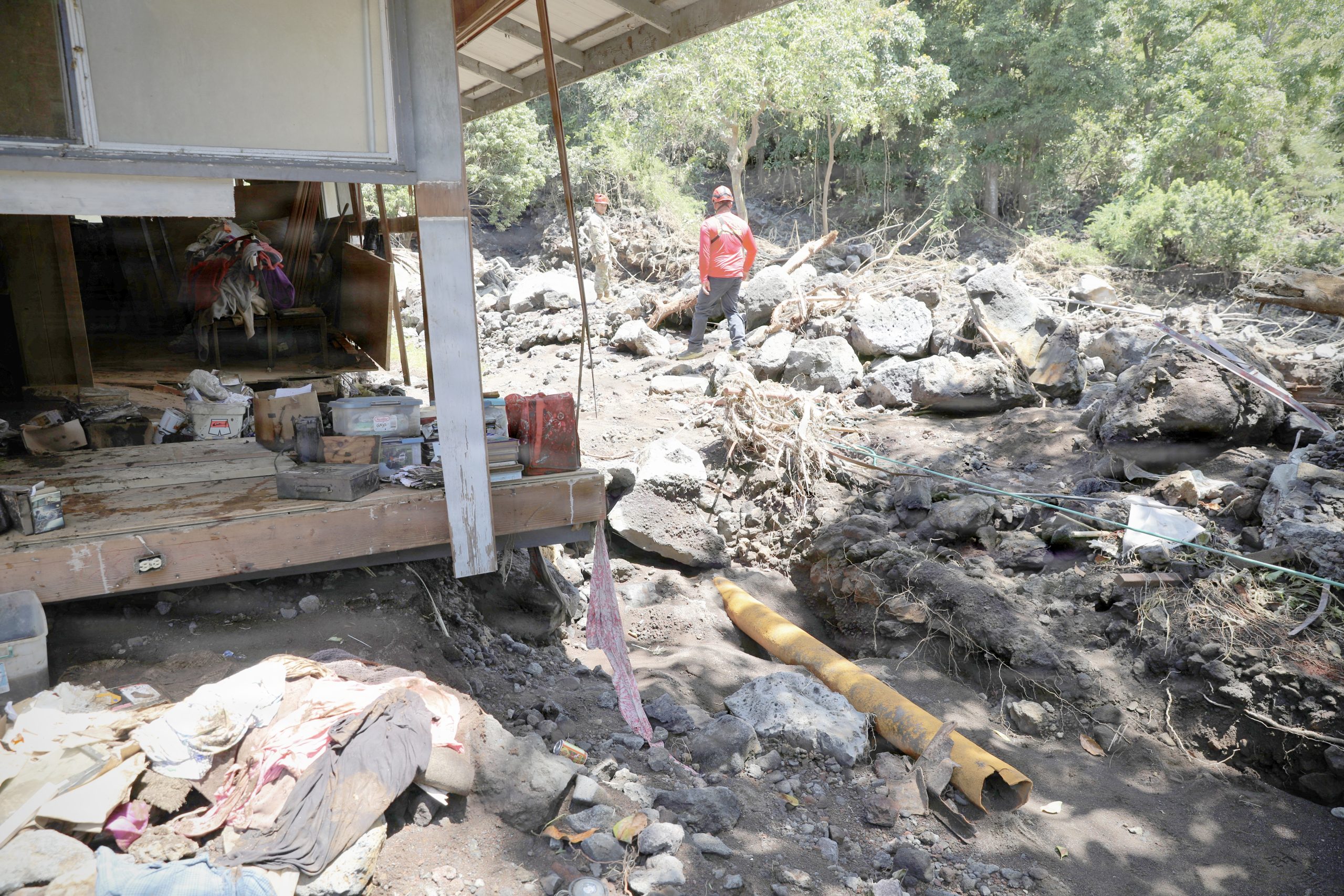
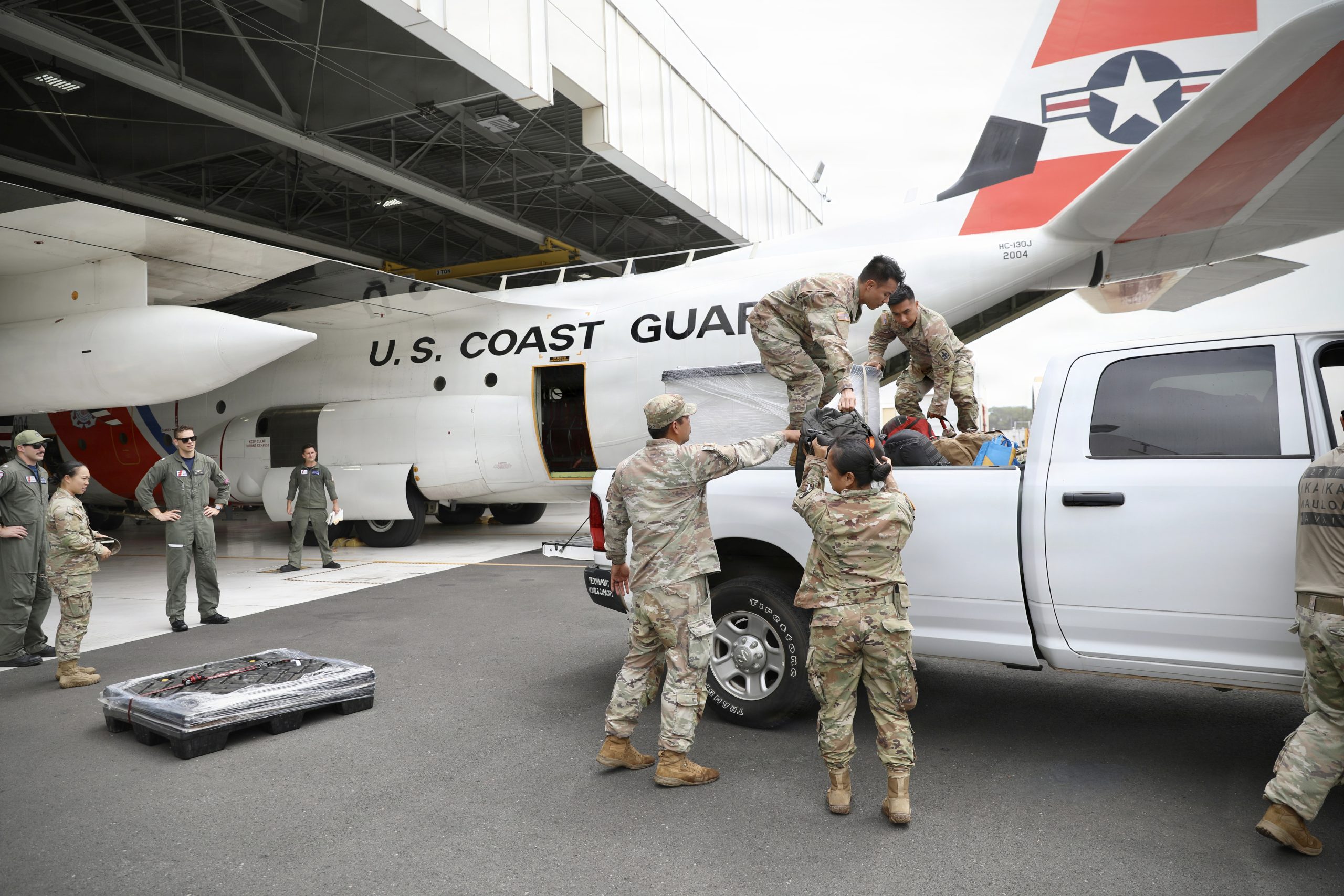
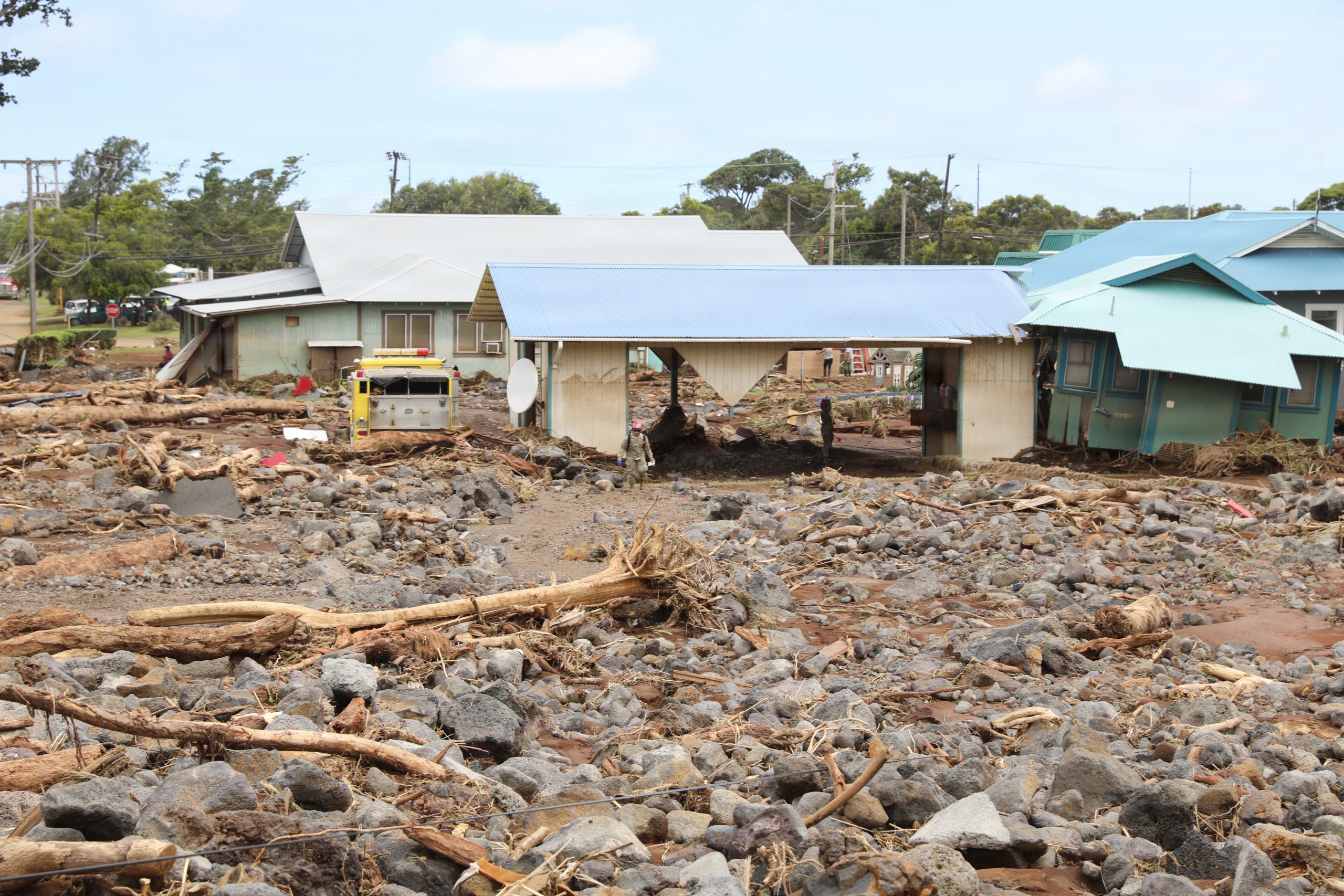
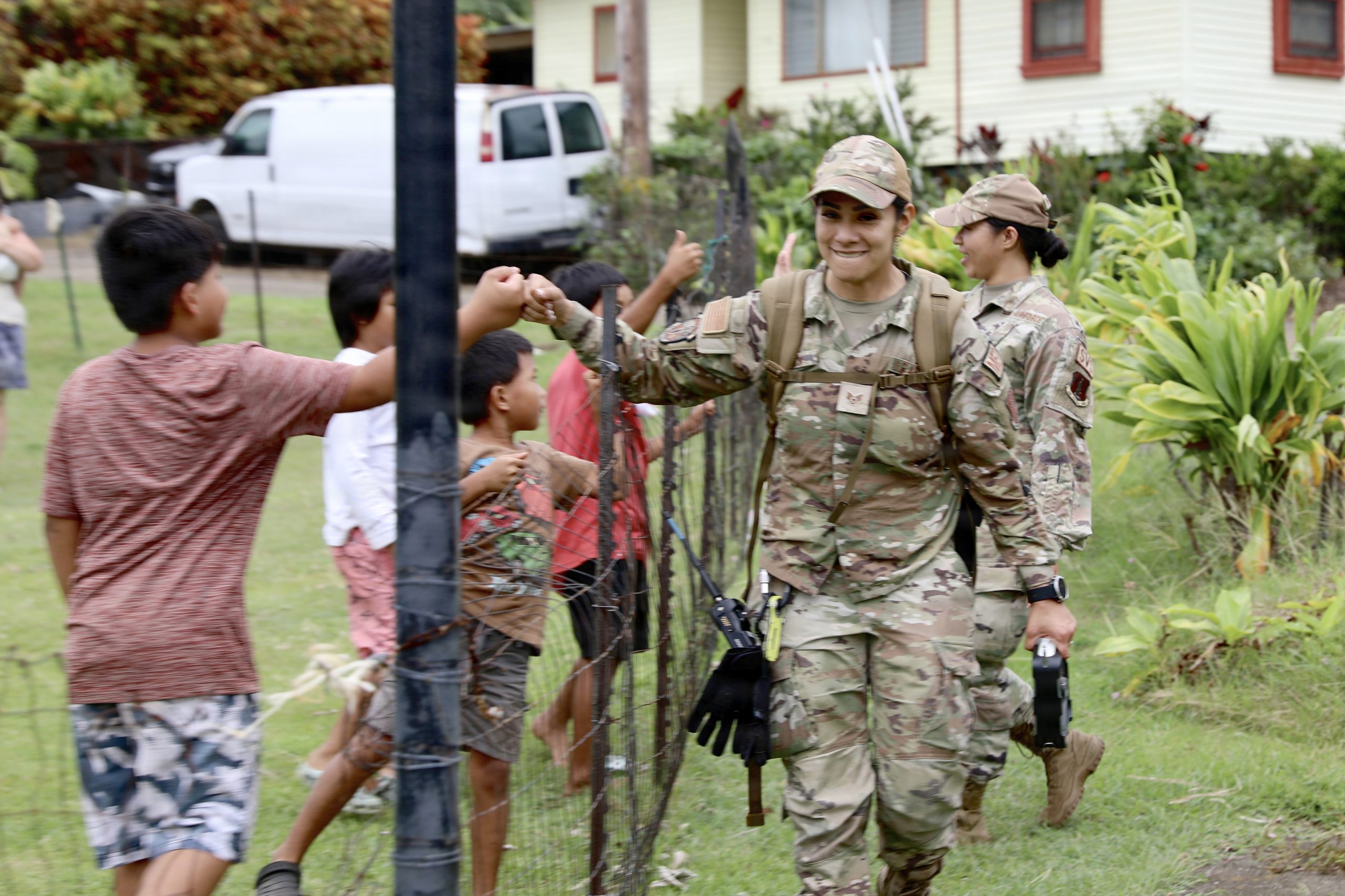
The Hawaiʻi National Guard’s 93rd Chemical, Biological, Radiological, and Nuclear Enhanced Response Force Package team conducted wide-area search operations in the Ka‘ū District on Hawai‘i Island following Tropical Cyclone Lala on Aug. 18. (U.S. Army National Guard photo by Spc. Daniel Barcenas)(Picture from the 2026 pūpūkahi Volume 56 No. 5)
Hawaiʻi National Guard supports Tropical Cyclone Lala response
By Rachel Blaire
State of Hawai‘i Department of Defense Public Affairs
The Hawai‘i National Guard’s 93rd Chemical, Biological, Radiological, Nuclear and Explosives Enhanced Response Force Package team walked over a damaged road to conduct area searches and wellness checks in the Ka‘ū District on Hawai‘i Island on Aug. 19 following impacts by Hurricane Lala. (U.S. Army National Guard photo by Spc. Daniel Barcenas)A Guardsman assessed damage in the Ka‘ū District on the Big Island alongside a Hawai‘i Fire Department member on August 20. (U.S Army National Guard photos by Spc. Daniel Barcenas)The Hawaii National Guard’s 93rd Chemical, Biological, Radiological, Nuclear and Explosives Enhanced Response Force Package team loaded essential equipment onto a U.S. Coast Guard C-130 in support of recovery operations at Barber’s Point on O‘ahu on Aug. 16. (U.S Army National Guard photo by Spc. Daniel Barcenas)Guardsmen assessed the damage at the fire station in Nā‘ālehu on the Big Island on Aug. 19. (U.S. Army National Guard photos by Spc. Daniel Barcenas)Members from the Hawaii National Guard’s 93rd Chemical, Biological, Radiological, Nuclear and Explosives Enhanced Response Force Package team greeted children in the Ka‘ū District on the Big Island on August 18. (U.S. Army National Guard photos by Spc. Daniel Barcenas)(Pictures from the 2026 pūpūkahi Volume 56 No. 5)
HONOLULU — The Hawaiʻi National Guard (HING) has concluded its response operations on Kauaʻi and Oʻahu following the impacts of Tropical Cyclone Lala, while soldiers and airmen continue supporting recovery efforts on Hawaiʻi Island and Maui.
At the height of the response, as many as 250 HING soldiers and airmen were activated on state active duty to support state and county emergency management agencies and provide critical capabilities to communities affected by the storm.
“Our soldiers and airmen answered the call to service, putting community first in support of response and recovery efforts during Tropical Cyclone Lala,” said Maj. Gen. Stephen Logan, adjutant general of the state of Hawaiʻi. “Their commitment to helping neighbors in need, from lifesaving rescues to damage assessments, reflect their dedication to help families begin to recover.”
HING personnel worked alongside county emergency management officials and first responders as conditions improved and recovery operations began. National Guard liaison officers were embedded within county Emergency Operations Centers, the Hawaiʻi Emergency Management Agency (HIEMA) and the Honolulu Police Department Joint Operations Center to help coordinate requests for assistance and connect HING capabilities with local needs.
As Tropical Cyclone Lala moved through the Hawaiian Islands, HING personnel provided a range of emergency response and recovery capabilities, including high-water rescues and evacuations, debris clearance, delivery of donated supplies, damage assessments and aerial reconnaissance.
High-wheeled vehicle teams positioned on Hawaiʻi Island assisted 16 residents and rescued two emergency medical paramedics who became stranded by the floodwaters.
On Hawaiʻi Island, the response continues in the remote Kaʻū District, where soldiers and airmen assigned to the Hawaiʻi National Guard’s 93rd Chemical, Biological, Radiological and Nuclear Enhanced Response Force Package (93rd CERFP) partnered with the Hawaiʻi Fire Department to conduct door-to-door safety and wellness checks.
“What we saw when we first came out to site was all the landslides from the top of the cemetery and down to the main road. So we knew that already that there are going to be a lot of uneven spaces, a lot of rubble piles,” said Senior Master Sgt. Hyurn Chu, 154th Force Support Squadron, a member of the 93rd CERFP.
As of Aug. 21, teams visited over 320 homes, checking on residents and helping identify needs in communities affected by the storm.
The HING continues to support Maui County’s recovery efforts with personnel integrated into eight joint damage assessment teams. The teams completed 11 comprehensive assessments of storm-affected areas, providing local officials with information to help arrange recovery needs.
Senior state and county leaders also conducted an aerial assessment flight to survey widespread storm damage. The flight included the governor, Hawaiʻi County mayor and the adjutant general, providing an aerial perspective of affected communities and infrastructure.
While the HING has concluded its response operations on Kauaʻi and Oʻahu, personnel remain ready to support Hawaiʻi and Maui counties as recovery efforts continue.
The HING continues to coordinate with county emergency management agencies and HIEMA for additional requests for assistance. At the same time the HING is monitoring incoming Tropical Storm Moke and has begun pre-positioning assets in preparation for potential impacts to the state.
“We are preparing for Tropical Storm Moke by proactively repositioning personnel and equipment based on the latest forecast. This deliberate staging of our capabilities ensures we can rapidly respond to the hardest-hit areas the moment emergency requests for assistance are received from state and county managers,” said Brig. Gen. Damon Hogsten, Director of the Joint Staff, Hawaiʻi National Guard.
The experience gained from previous disaster responses, such as the Kona Low Storms in March, is helping shape the HING’s approach to Tropical Storm Moke.
“By continuously applying lessons learned from previous disasters, we have refined our response tactics. A key example is the close integration of our high-wheeled vehicle teams with local police and fire departments, ensuring life-saving assets are deployed precisely where they are needed most,” said Hogsten.
The response reflects the Hawaiʻi National Guard’s dual mission of serving the people of Hawaiʻi during times of crisis while maintaining readiness to fight and win America’s wars as part of the nation’s defense.
State of Hawai‘i Department of Defense Public Affairs
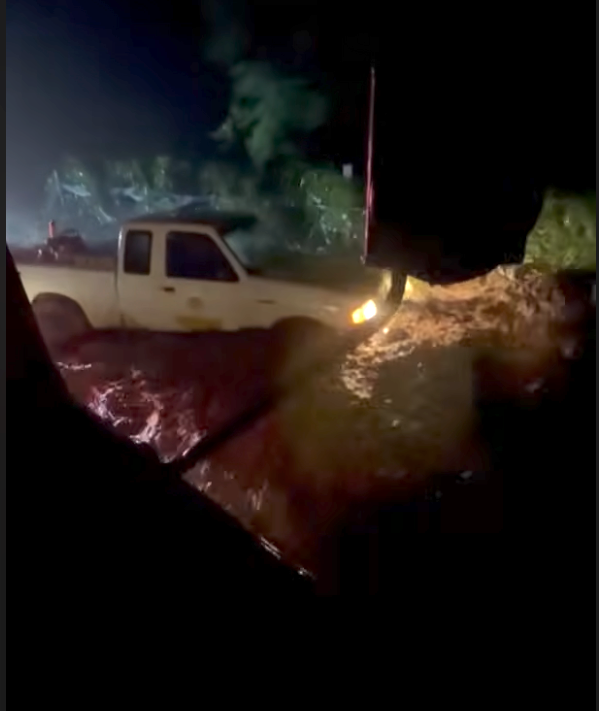
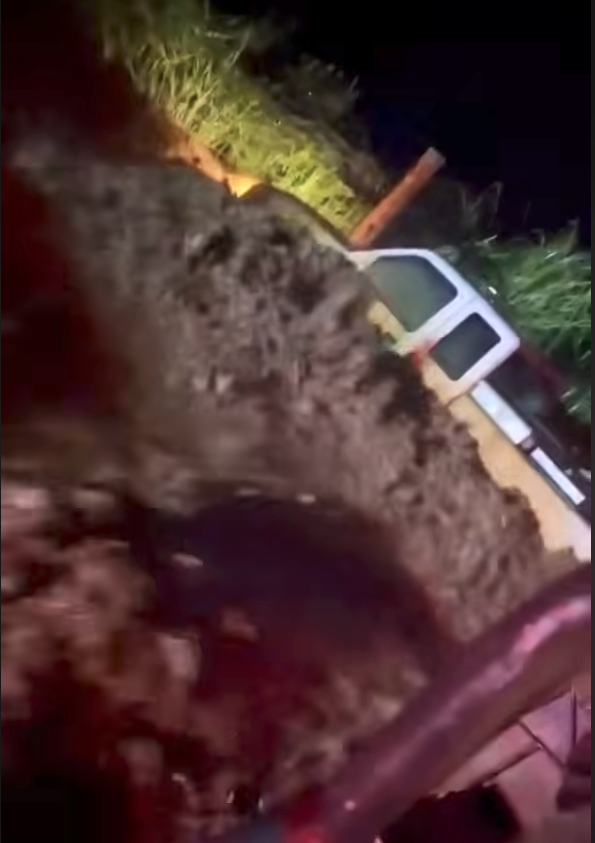
The Hawai‘i National Guardʻs Task Force Hawaiʻi responded to a dangerous high-water crossing to rescue two paramedics whose county truck became stranded by rapidly rising water in Nāʻālehu on the Big Island on Aug. 15. (Hawai‘i National Guard video footage)The Hawai‘i National Guardʻs Task Force Hawaiʻi responded to a dangerous high-water crossing to rescue two paramedics whose county truck became stranded by rapidly rising water in Nāʻālehu on the Big Island on Aug. 15. (Hawai‘i National Guard video footage)(Pictures from the 2026 pūpūkahi Volume 56 No. 5)
KAʻŪ DISTRICT, Hawaiʻi — As floodwaters rose across the Kaʻū District during Hurricane Lala, a Hawaiʻi National Guard high-water vehicle team was already returning from one rescue when another call came in: two emergency medical responders were stranded in their ambulance and needed help.
The soldiers were about a mile away when they received the request for assistance on August 15.
“They had just completed an individual rescue of a gentleman and were headed back to the fire station when we received the follow-on call requesting our assistance with the stranded EMS,” said Sgt. Darrick Salinas, 1st Squadron, 299th Cavalry Regiment. “We didn’t really have a lot of information on the full circumstances of their situation, just that their vehicle had stalled in high water.”
The team turned toward the stranded paramedics and as they approached, the conditions deteriorated. What had been roughly 2 feet of water earlier in their mission had risen to at least 5 feet by the time they reached the EMS personnel.
Floodwater spilled into the cab and bed of their high-water vehicle, while heavy rain and widespread power outages limited visibility. The soldiers also encountered debris carried by the floodwaters, including trees, rocks, furniture, trash cans and a county pickup truck.
“The biggest challenge was just the sheer velocity and volume of water that was coming at us,” Salinas said. “We were traveling from the bottom of the hill, kind of working our way up in elevation, so all of the floodwaters were essentially converging on our location.”
At times, the soldiers could not see the road beneath them.
“There was a huge risk of driving off the road along the entire duration of our route,” Salinas said. “The greatest risk was our vehicle being overwhelmed by water and becoming inoperable.”
When the soldiers reached the ambulance, the two paramedics climbed into the Guard vehicle.
Salinas, who was driving, immediately shifted his focus from reaching the stranded responders to getting everyone safely out of the floodwaters.
“We knew we were their last hope of escaping the rising water, and we just had to do whatever it took to bring them into our vehicle,” Salinas said.
The original plan was to extract the paramedics and continue toward the fire station. But with water rapidly rushing toward them, the team determined that continuing forward was no longer a viable option.
Instead, they decided to reverse out of the flooded roadway. Everyone aboard the vehicle helped guide Salinas as he backed through approximately a mile of floodwater toward a police station.
With severely restricted visibility, the soldiers and paramedics called out road edges and used power lines, fences and speed-limit signs to help determine where the road was beneath them.
“For me, as the driver of the vehicle, it was simply getting everybody to where they needed to be, safely,” Salinas said. “Making sure that we mitigated that risk as best we could, and then once we were out, just trying to get everyone to safety was on my mind.”
Afterwards, the paramedics returned to their mission of helping others affected by the storm. Looking back on the rescue and the escape from the flood waters, Salinas credited his team who worked alongside him in the flooded vehicle.
“My soldiers were awesome that night,” he said. “For me, the success behind that mission was 100% on t
State of Hawai‘i Department of Defense Public Affairs
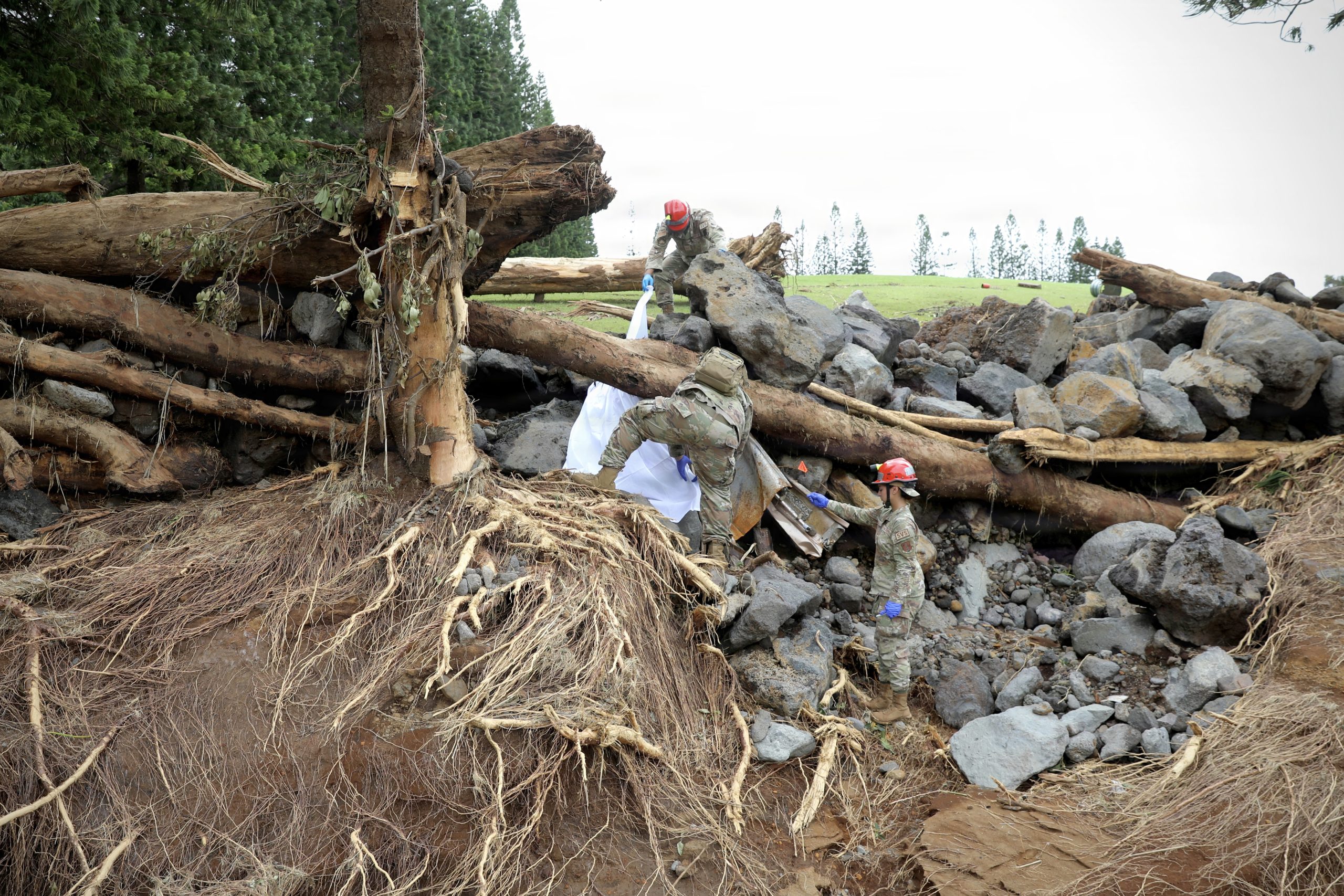
Hawai‘i National Guard worked near a debris-filled area in the Ka’ū District on Hawai‘i Island on Aug. 19 following impacts by Hurricane Lala. (U.S. Army National Guard photo by Spc. Daniel Barcenas)(Picture from the 2026 pūpūkahi Volume 56 No. 5)
KAʻŪ DISTRICT, Hawaiʻi— In the aftermath of Hurricane Lala, roads across Hawaiʻi Island were buried beneath mud, rocks, trees and other debris, making it difficult for residents, emergency responders and utility crews to move through some of the hardest-hit communities.
For soldiers and airmen of the Hawaiʻi National Guard, the mission shifted quickly from rescuing people trapped by floodwaters to helping communities begin the long process of recovery.
Guardsmen worked alongside Hawaiʻi County personnel to clear debris from roadways and homes, helping restore access for emergency vehicles and the delivery of critical supplies.
Each morning, teams linked up with county personnel and moved into assigned areas of operation to clear roads and make them more accessible.
“We sent our trucks out with them, assisting with kind of clearing roadways and make everything a little more passable for emergency vehicles and supplies to get delivered,” said Sgt. Dearrick Salinas, 1st Squadron, 299th Cavalry Regiment.
The conditions left behind by the storm presented a different set of challenges.
“When we first arrived, a lot of the roads were covered in dirt and debris, trees were down, there were a lot of rocks and rubble all over, so it was really hard to get through the roads,” said Spc. Brianna Diazescobar, 1st Squadron, 299th Cavalry Regiment.
The debris was not limited to natural materials, Guardsmen encountered appliances, as well as vehicles and other belongings that had been displaced by the flooding.
Some of the most difficult work took place away from the roads, they entered muddy yards and garages to help residents regain access to their homes.
Diazescobar recalled helping one resident whose garage was filled with mud more than ankle-deep. The Guardsmen used shovels to clear a path through the mud, which contained debris, allowing the resident to reach the back of his home.
“It definitely feels like an honor to help out the community and make things easier for them,” Diazescobar said. “I know it’s a very difficult time, so it just feels really good to help out, especially being here from the Big Island.”
The work required Guardsmen to balance speed with safety. Muddy conditions, unstable debris and difficult-to-reach areas created hazards as teams worked around homes and properties.
“I feel like the hardest part was trying not to fall and slip, minimize the safety hazards we had out there,” Diazescobar said.
The debris-clearance mission was one part of a broader Hawaiʻi National Guard response to Hurricane Lala. At the height of the response, as many as 250 Guardsmen were activated on state active duty to support state and county emergency management agencies. Missions included high-water rescues and evacuations, wellness checks, debris clearance, damage assessments, aerial reconnaissance and delivery of donated supplies.
On Hawaiʻi Island, debris teams cleared more than 11,150 meters that had over 58 tons of debris from roadways and homes as of Sept. 4, 2026.
The Guard’s recovery mission also extended to Maui County, where Task Force Maui personnel worked alongside county partners to assess 80 homes with storm damage and support debris-removal efforts clearing 700 meters of road.
The Hawaiʻi National Guard continues to work with Hawaiʻi county as communities recover from Hurricane Lala, providing manpower and specialized capabilities where requested.
For Guardsmen like Salinas and Diazescobar, the work is more than moving debris. It is about helping residents regain access to their homes and creating a safer path forward after the storm.
“I’m proud to have been a part of a team that could come and help out the community,” Diazescobar said.
State of Hawai‘i Department of Defense Public Affairs
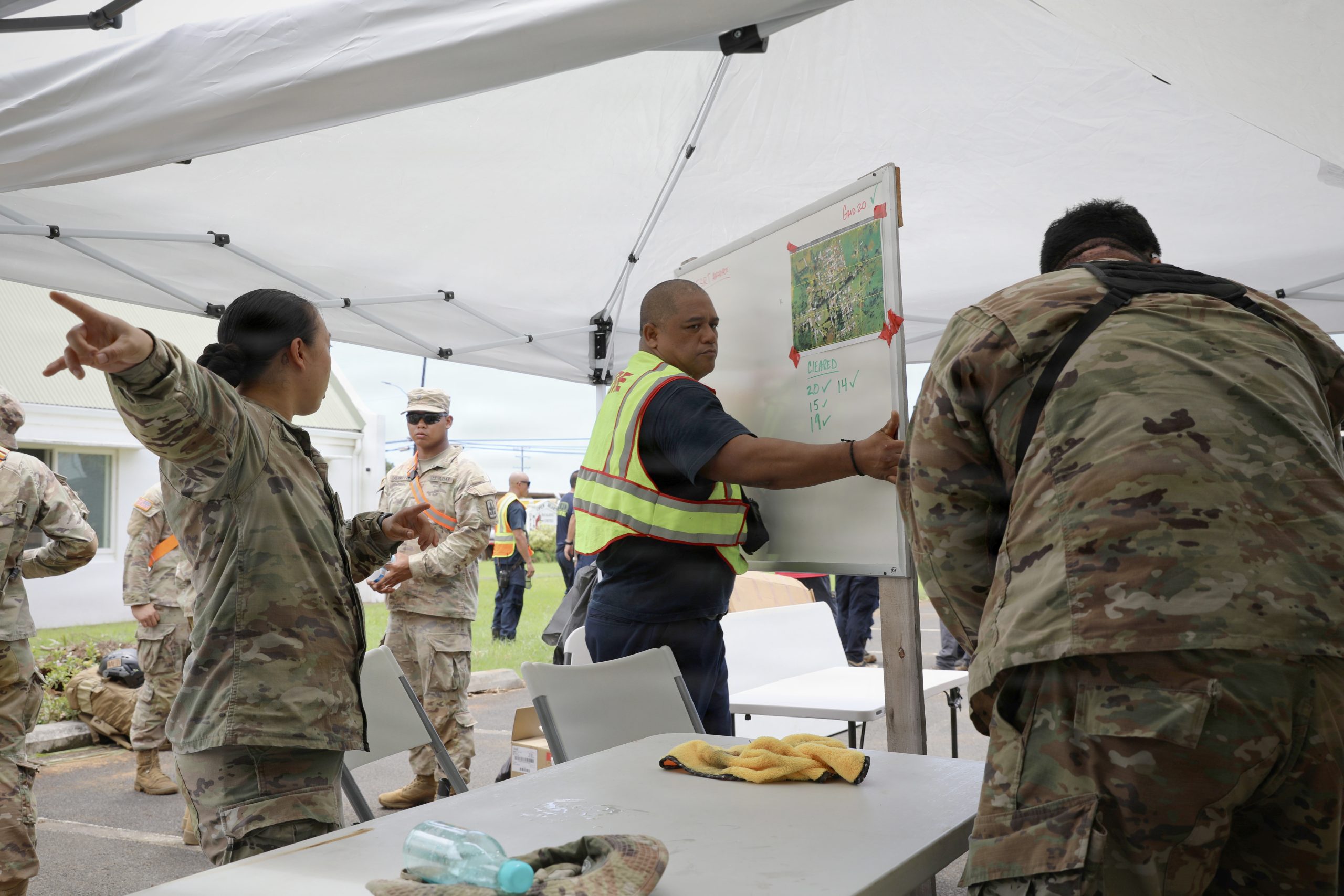
The Hawaii National Guard alongside first responders set up an area of operations in the Ka’u District, Hawaii, Aug. 19, 2026. Current operations in support of Hurricane Lala include, high water vehicle rescues, evacuations from flood-affected areas, door-to-door wellness checks in flood-affected areas and debris removal. The HING remains ready to support any further requests from the county EOC. (U.S. Army National Guard photo by Spc. Daniel Barcenas)(Picture from the 2026 pūpūkahi Volume 56 No. 5)
NĀʻĀLEHU, Hawaiʻi — Hurricane Lala brought heavy rain, flooding and damaging winds to Hawaiʻi Island in August 2026, impacting communities across the island and triggering rescues and widespread response efforts. In the Kaʻū District, floodwaters inundated roads and low-lying areas, damaged property and infrastructure, and caused landslides and debris flows.
Among the storm’s impacts was significant damage to Nāʻālehu Cemetery, where floodwaters disturbed burial sites and carried human remains and other cemetery materials beyond the cemetery grounds.
In the storm’s aftermath, the Hawaiʻi National Guard joined Hawaiʻi County, cultural practitioners and subject-matter experts in a coordinated effort to document, recover and protect the displaced burials.
“The discovery of burials within the flood area was heartbreaking for the Nāʻālehu community, and their pain is shared by our entire island,” said Hawaiʻi County Mayor Kimo Alameda. “We want to assure the community that every step of this recovery process is being carried out with compassion, care and respect for the deceased and their descendants.”
The documentation efforts as of Sept. 1, 2026, have identified over 140 remains in the Nāʻālehu area and the multi-agency effort is still finding more remains in its second month of work.
For members of the Hawaiʻi National Guard’s 93rd Chemical, Biological, Radiological, and Nuclear Enhanced Response Force Package (93rd CERF-P), the mission required more than specialized search and recovery skills. It required patience, coordination and respect for a site that holds deep cultural and personal significance for the Nāʻālehu community.
Chief Master Sgt. Hyurn Chu, a member of the 154th Force Support Squadron and the 93rd CERF-P’s fatality search and recovery team, recalled the conditions when the team first arrived.
“We saw all the landslides from the top of the cemetery and down to the main road,” Chu said. “We knew already that there are going to be a lot of uneven spaces, a lot of rubble piles, and knowing that most of the debris came from the cemetery, that there’s possible remains underneath all the rubble.”
Before beginning recovery operations, the Guard coordinated with community members and local responders to ensure the work was conducted appropriately and that access to sensitive areas was authorized.
“We want to make sure that we give proper respects and we’re not damaging anything that’s respected by the community,” Chu said.
The recovery effort brought together a range of expertise, including cultural practitioners, archaeologists, forensic anthropologists and osteologists, with guidance and support from the Maui Department of ʻŌiwi Resources and the Hawaiʻi State Department of Health.
The 93rd CERF-P’s training prepared its members to safely navigate unstable debris while carefully processing and recovering remains.
“Learning the skill sets of properly processing remains, being very respectful, knowing that they are part of our loved ones, and knowing that we want to make sure that we take care of others like how we want to be taken cared of,” Chu said.
Cultural practices were incorporated throughout the operation. Before work began, participating agencies gathered for an opening ceremony and blessing in recognition of the sacred nature of the site.
When remains were recovered, Hawaiian cultural practitioners were given the opportunity to conduct appropriate practices and pay their respects before the remains were removed and transported. At the end of operations, the team conducted a closing ceremony.
For Chu, the process demonstrated the importance of bringing different agencies and communities together during a disaster.
“Even though we may not all have the same spiritual mindset, we all can come together and understand that we want to make sure that we help each other,” Chu said.
The area around the displaced burials was protected from debris removal while the recovery effort is underway.
The effort reflects a broader reality of disaster response in Hawaiʻi, where recovery can involve not only restoring roads and infrastructure, but also protecting cultural sites and helping families recover what was lost.
For the Hawaiʻi National Guard, the mission at Nāʻālehu Cemetery provided an opportunity to apply specialized capabilities in support of local authorities while honoring the people and traditions connected to the site.
“We want to make sure that we’re giving proper closure here and to the loved ones,” Chu said.
From the Middle East to Waiʻōhinu: Deployed soldier expresses deep gratitude for Hawaiʻi National Guard
By Rachel Blaire
State of Hawai‘i Department of Defense Public Affairs
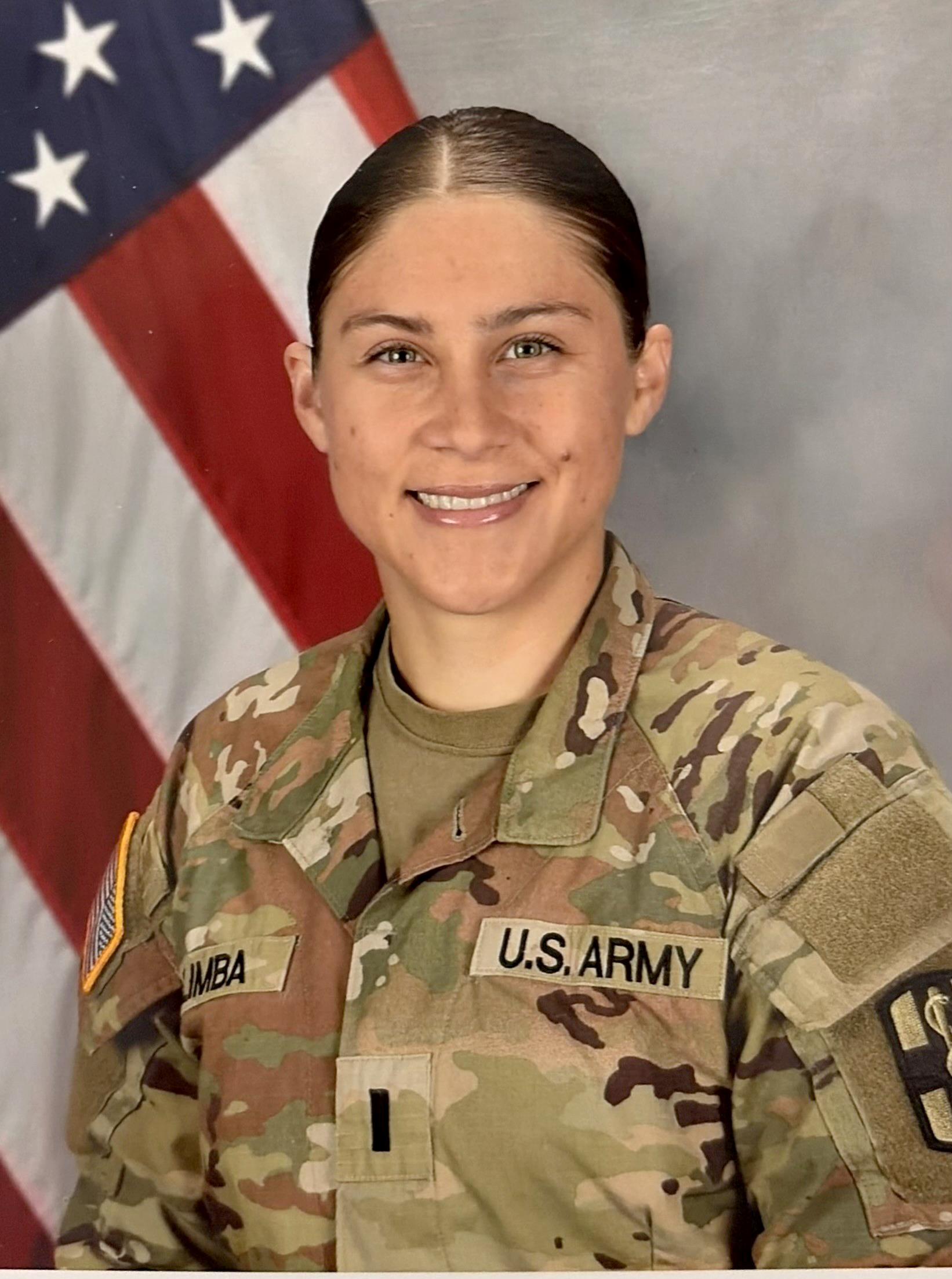
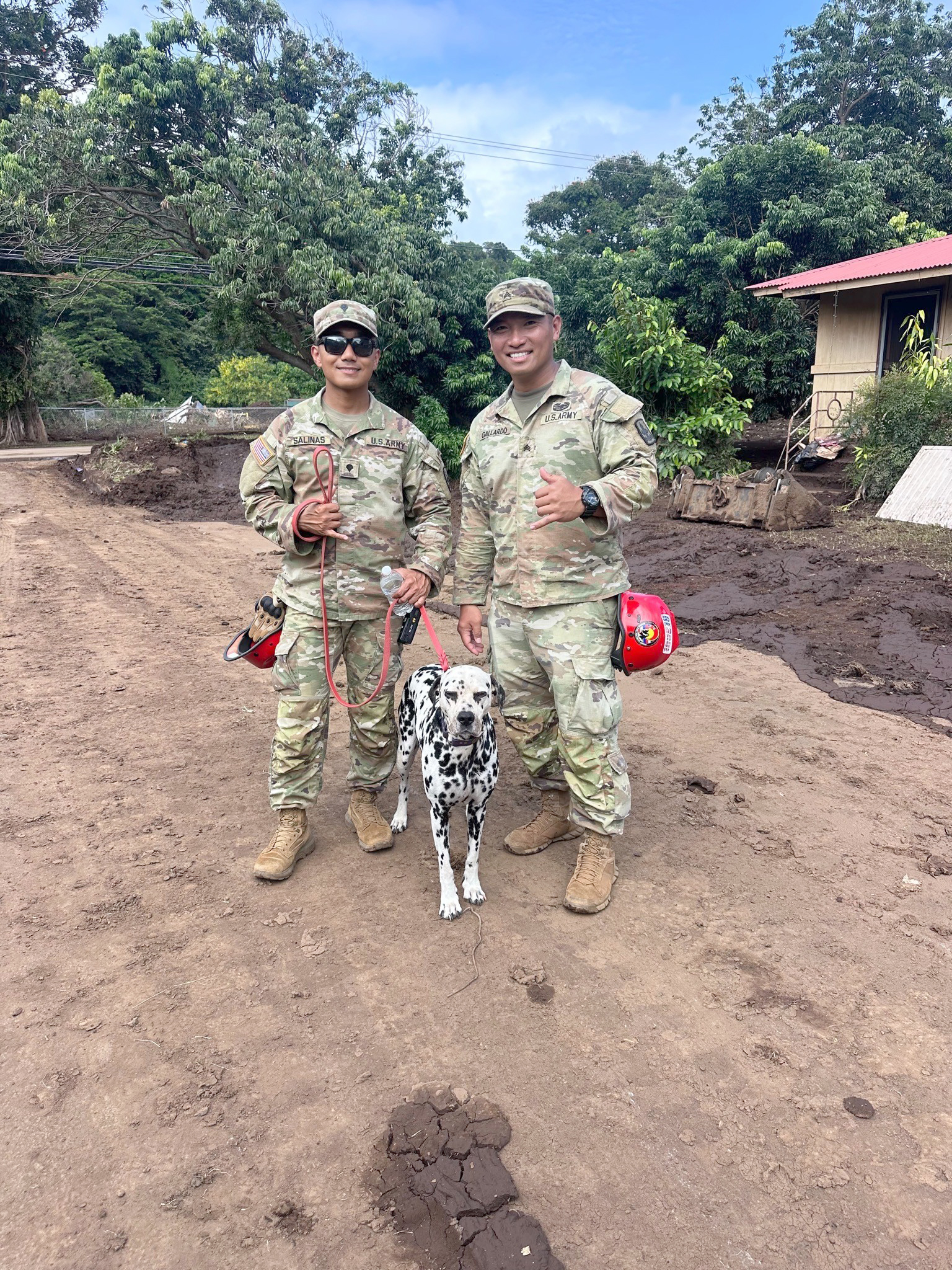
1st Lt. Makena Galimba (U.S. Army photo)U.S. Army Spc. Elvis Lorenz Salinas, left, and Sgt. Paul Gallardo, both assigned to the 29th Infantry Brigade Combat Team, Hawaiʻi Army National Guard, stood in the driveway of the Galimba home with the family dog, during disaster response operations in Waiʻōhinu, Hawaiʻi, August 2026. (Photo courtesy 1st Lt. Makena Galimba)(Pictures from the 2026 pūpūkahi Volume 56 No. 5)
WAIʻŌHINU, Hawaiʻi — While serving thousands of miles away in the Middle East, U.S. Army 1st Lt. Makena Galimba experienced the anxiety that comes with watching a natural disaster strike your hometown from afar.
Galimba, a 66H Medical-Surgical Nurse with the 131st Field Hospital, was deployed supporting Operation Epic Fury, when Hurricane Lala swept through the Hawaiian Islands. Her thoughts immediately turned to her family in the remote town of Waiʻōhinu on Hawaiʻi Island, one of the areas heavily impacted by the storm and where her family has lived for four generations.
For the first few days after the storm, a complete power and cellular blackout left Galimba, unable to reach her loved ones.
“Like many others, they were impacted by Hurricane Lala,” Galimba said. “For the first few days after the storm, I had no contact with them due to power and cellular outages.”
Despite the communication blackout and the distance, Galimba found comfort in knowing who would be responding to the crisis back home.
“Throughout that time, it gave me great peace to know that the National Guard was being called in to assist the community,” she said.
Relief arrived when communications were finally restored, her father sent her a photograph from their home in Waiʻōhinu.
The image showed Sgt. Paul Gallardo and Spc. Elvis Lorenz Salinas, soldiers assigned to the Hawaiʻi National Guard’s 29th Infantry Brigade Combat Team (29th IBCT), standing in her family’s driveway where they had been assisting with cleanup and checking on the family’s welfare.
“I cannot express in words how much gratitude I have for them, the entire 29th IBCT and the Hawaiʻi National Guard,” Galimba said.
For Galimba, seeing her fellow service members helping her family bridged the gap between her mission overseas and the recovery efforts at home.
“I am beyond proud to serve in an organization that comes together to take care of its own, both at home and overseas,” she added.
The response in Waiʻōhinu was part of a larger mobilization by the Hawaiʻi National Guard, whose members deployed throughout the Kaʻū District to assist residents with wellness checks, and debris clearance in the wake of Hurricane Lala.
Recognizing the long hours and preparation that go into disaster response, Galimba sent a message of deep gratitude back to the islands to thank those working on the front lines of the recovery effort.
“I want to extend a big mahalo to everyone with boots on the ground in Kaʻū, as well as those working behind the scenes,” Galimba wrote. “Please know that your sacrifice and dedication have not gone unnoticed — not only today, but in all the drill weekends and training exercises that led to this moment. Again, I send a big mahalo to my brothers and sisters helping at home.”
EIN Presswire provides this news content "as is" without warranty of any kind. We do not accept any responsibility or liability
for the accuracy, content, images, videos, licenses, completeness, legality, or reliability of the information contained in this
article. If you have any complaints or copyright issues related to this article, kindly contact the author above.