

Automotive Brake Systems Market Forecast Report with Segment Analysis and Strategic Industry Insights
automotive_brake_systems_global_market_report_Comp_And_Segment.webp
automotive_brake_systems_global_market_report_All_Infos.webp
automotive_brake_systems_global_market_report_Regions_And_Drivers.webp
The Business Research Company's Automotive Brake Systems Market Report 2026 – Market Size, Trends, And Global Forecast 2026-2035
LONDON, GREATER LONDON, UNITED KINGDOM, October 12, 2026 /EINPresswire.com/ -- "The automotive brake systems market is evolving steadily as safety, performance, and innovation continue to shape the industry. With increasing emphasis on advanced technologies and electrification, this sector is set to expand significantly over the coming years. Below is a comprehensive overview of market size, growth drivers, key players, and emerging trends that are defining the future of automotive braking solutions.
Market Size and Growth Prospects for Automotive Brake Systems
By 2030, the automotive brake systems market is expected to surpass $56 billion. This segment forms roughly 5% of the larger Transport Vehicle Components market, which is projected to reach about $1,140 billion by the same year. Within the expansive Transport industry forecasted at $9,400 billion by 2030, automotive brake systems will account for nearly 1% of the total market value. These figures underscore the substantial role brake systems play within the broader vehicle components landscape.
Request A Free Sample Of The Automotive Brake Systems Market Report
https://thebusinessresearchcompany.com/sample_request?id=7196&type=smp&name=Automotive%20Brake%20Systems%20Market%20Report%202026&utm_source=EINPresswire&utm_medium=Paid&utm_campaign=Oct_PR
Projected CAGR of the Automotive Brake Systems Market
The automotive brake systems market is anticipated to maintain a strong compound annual growth rate (CAGR) of 7% through 2030. This steady expansion reflects growing demand driven by technological advancements and regulatory pressures that emphasize vehicle safety improvements worldwide.
Regional Leadership in Automotive Brake Systems Market Growth
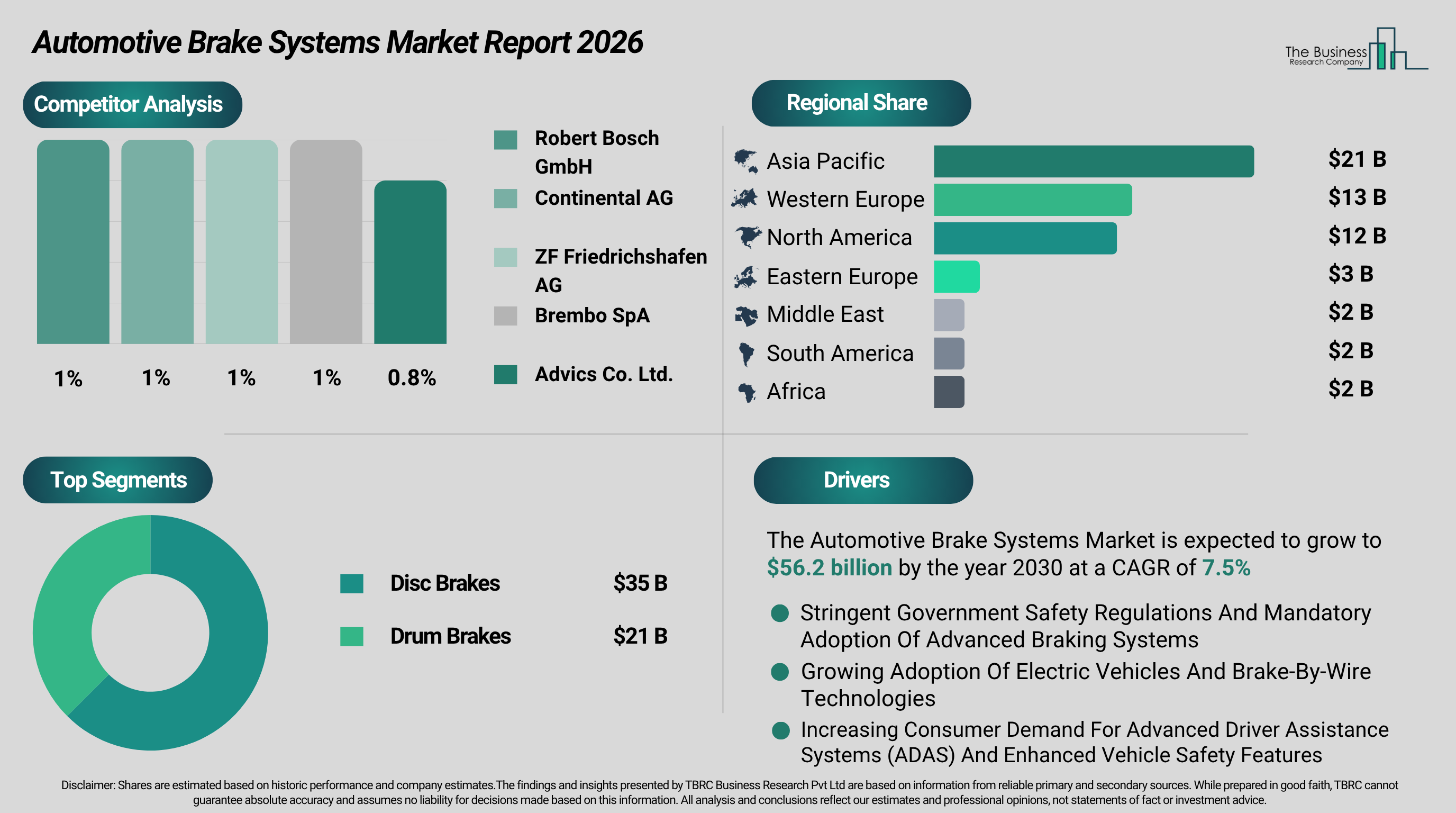
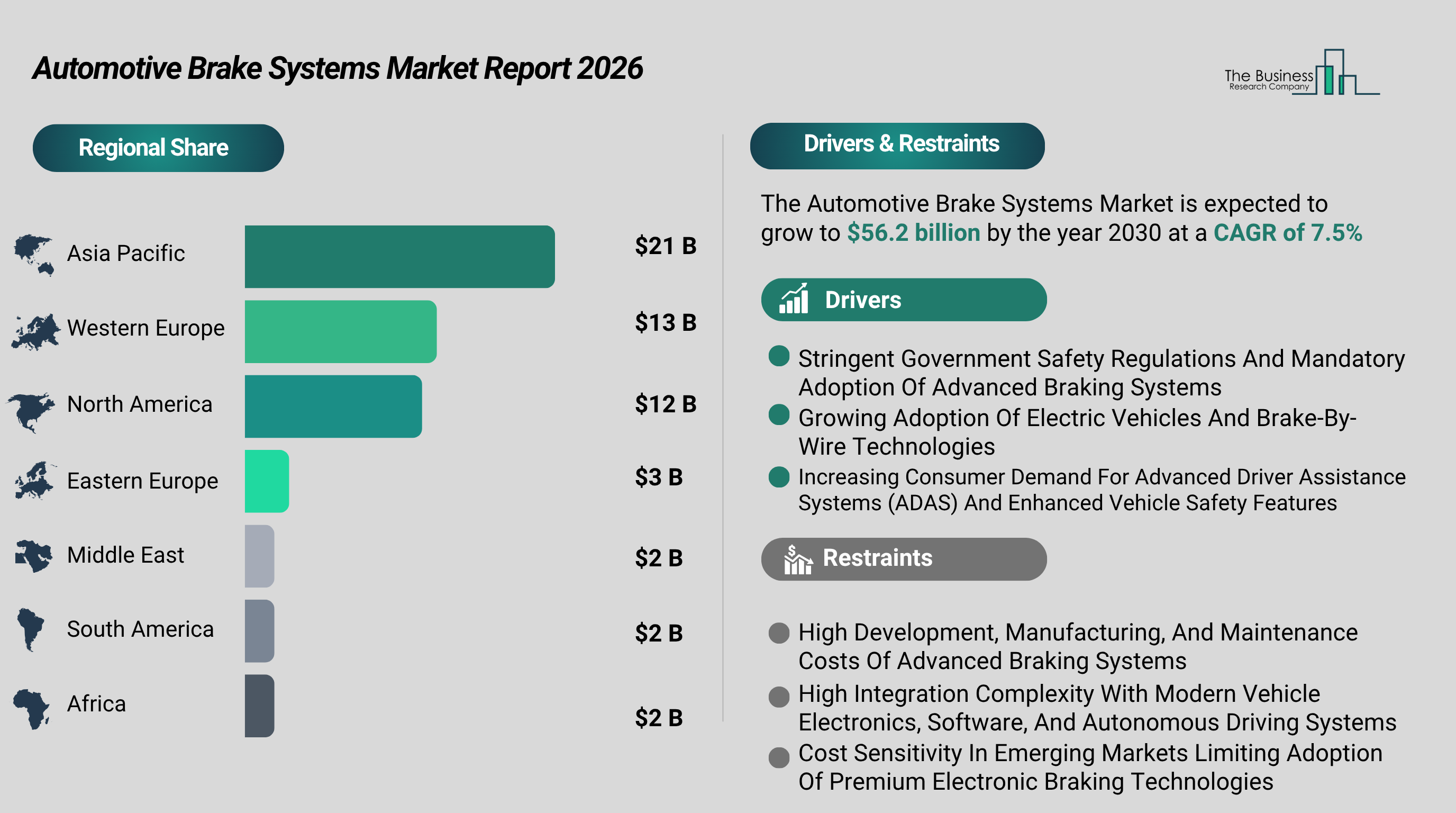
Asia-Pacific is set to lead the automotive brake systems market in 2030, valued at $21 billion, rising from $15 billion in 2025 at a 7% CAGR. This growth is fueled by increased vehicle production and sales in emerging markets, higher demand for sophisticated safety braking systems, and the rising adoption of electric and hybrid vehicles that require specialized brake technologies. Additionally, ongoing investments in automotive manufacturing and mobility infrastructure are bolstering the region’s market dominance.
Access The Detailed Automotive Brake Systems Market Report Here
https://thebusinessresearchcompany.com/report/automotive-brake-systems-global-market-report?utm_source=EINPresswire&utm_medium=Paid&utm_campaign=Oct_PR
USA’s Position as a Key Automotive Brake Systems Market Player
The United States is forecasted to be the largest single-country market for automotive brake systems by 2030, reaching $11 billion, up from $8 billion in 2025 with a CAGR of 6%. Factors contributing to this growth include the integration of advanced driver assistance systems (ADAS) linked to braking functions, replacement demand for aging brake components, increased popularity of SUVs and pickup trucks needing high-performance brakes, and continued investment in next-generation safety technologies.
Breakdown of Automotive Brake Systems by Product Type
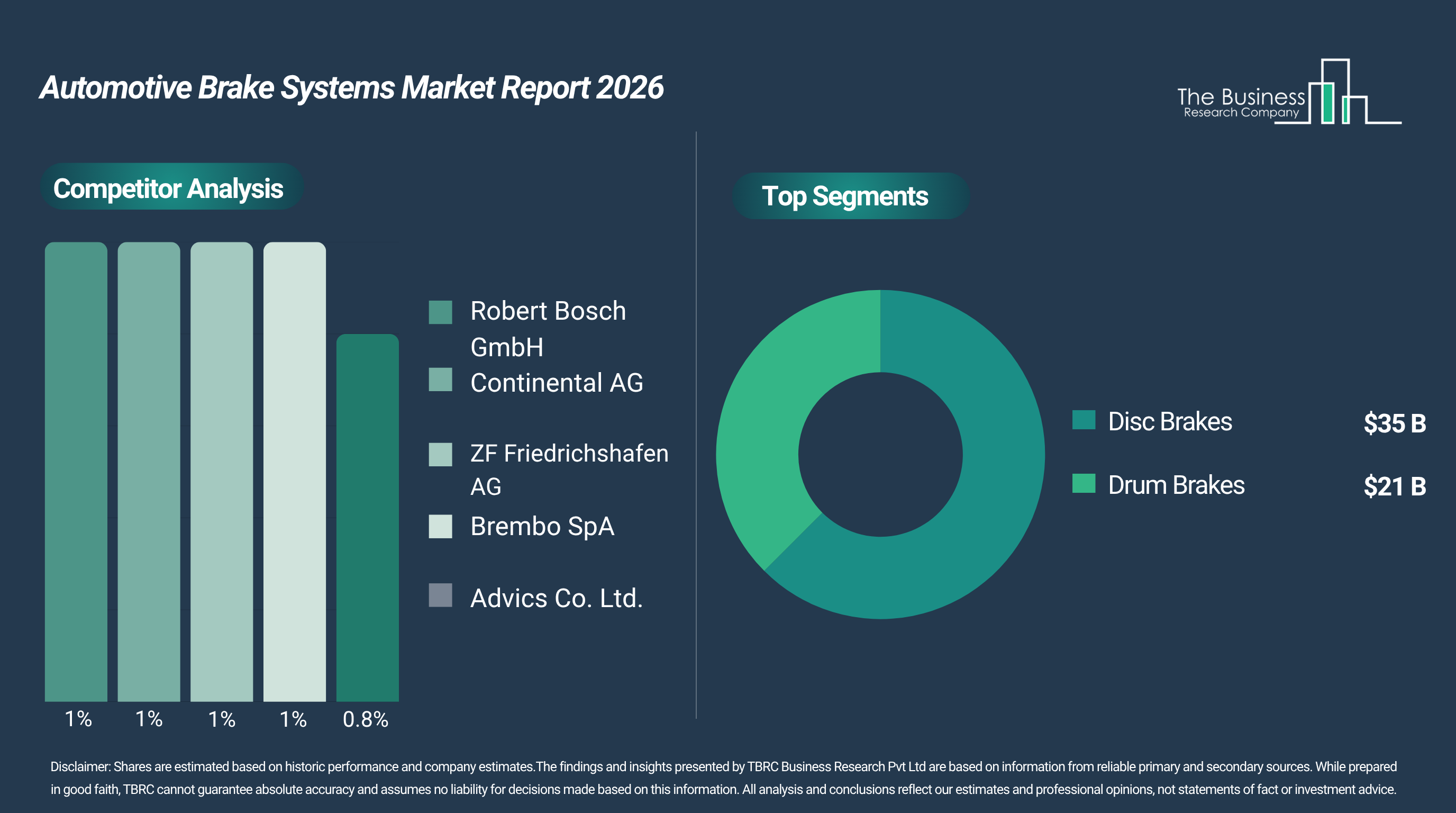
Within the market, disc brakes will dominate product-wise by 2030, holding 63% of the share, equivalent to $35 billion. Their popularity stems from superior heat dissipation capabilities, suitability for high-speed and performance vehicles, growing demand for lightweight brake components that enhance fuel efficiency, and material innovations improving durability and stopping power. Drum brakes remain relevant but will occupy a smaller portion of the market.
Detailed Segmentation of Automotive Brake Systems
The market is also segmented by technology into antilock braking systems (ABS), electronic stability control (ESC), traction control systems (TCS), and electronic brakeforce distribution (EBD). Regarding sales channels, the market divides into original equipment manufacturers (OEMs) and aftermarket segments. Vehicle type segmentation includes passenger cars, light-commercial vehicles (LCV), trucks, and buses, covering a comprehensive range of end-user applications.
Primary Drivers Behind Automotive Brake Systems Market Expansion
One major driver is the enforcement of stricter vehicle safety regulations, which mandate features like ABS, ESC, and automatic emergency braking in increasing numbers of vehicle classes. Compliance with tougher safety rating standards encourages automakers to innovate intelligent braking systems and electronic control technologies, contributing an estimated 2.5% annual market growth.
Another key factor is the rapid proliferation of electric vehicles and the adoption of brake-by-wire technologies. Electrified vehicles require integrated braking systems that combine regenerative and friction braking for optimized energy recovery and stability. This trend fuels demand for electronic brake controllers, intelligent actuators, lightweight materials, and software-based braking solutions, adding around 2.3% growth annually.
Rising consumer interest in advanced driver assistance systems (ADAS) also propels the market forward. Intelligent braking is essential for features such as adaptive cruise control, lane keeping assistance, forward collision warning, and automatic emergency braking. The competitive push toward safer vehicles and premium safety packages is projected to contribute roughly 2% annual growth.
Growth Opportunities Within Product Segments of Automotive Brake Systems
The combined market potential of disc brakes and drum brakes is significant, expected to add over $17 billion by 2030. Disc brakes alone will grow by $11 billion, with drum brakes contributing an additional $6 billion between 2025 and 2030. This growth will be driven by advances in lightweight materials, electronic control integration, performance demands from electric and autonomous vehicles, and improvements in component durability, thermal management, and intelligent diagnostics.
Competitive Landscape in the Automotive Brake Systems Market
Global manufacturers specializing in braking technologies and automotive safety components dominate this sector. They focus on innovations such as advanced braking electronics, high-performance friction materials, precise hydraulic systems, and intelligent brake management. Success in the market depends on reliability, adherence to regulatory standards, effective braking performance for electrified vehicles, and ongoing engineering efforts. Stakeholders benefit from understanding this competitive environment to identify opportunities for collaboration, innovation, and growth.
Leading Company in Automotive Brake Systems Market Share by 2025
Robert Bosch GmbH holds the top position in global automotive brake systems sales for 2025, capturing roughly 1% of the market. Its mobility – vehicle motion division supplies hydraulic braking systems, electronic stability control, integrated brake boosters, and advanced brake control units that enhance safety and precision across both passenger and commercial vehicles.
Market Distribution Among Top Players
The automotive brake systems market is notably fragmented, with the top 10 companies collectively accounting for just 9% of total revenue in 2025. This reflects the specialized engineering expertise required, diverse vehicle platform demands, and the increasing implementation of advanced braking technologies. Key firms sustain their positions through broad braking product lines, strong OEM partnerships, global manufacturing capacities, and ongoing advancements in electronic braking, lightweight components, and safety solutions. As demand rises for electric and autonomous vehicles, these companies are expected to strengthen their foothold by innovating and expanding production.
Major players by revenue share in 2025 include Robert Bosch GmbH, Continental AG, ZF Friedrichshafen AG, Brembo SpA, Advics Co. Ltd., Knorr-Bremse AG, Akebono Brake Industry Co. Ltd., Aisin Seiki Co. Ltd., Nisshinbo Holdings Inc., and Bendix Commercial Vehicle Systems LLC – each holding approximately 1% of the market.
Key Companies Driving the Automotive Brake Systems Sector
Besides the top players, other important companies in the automotive brake systems industry include TMD Friction Holdings GmbH, Hella Pagid GmbH, FTE automotive Group, Performance Friction Corporation, Wilwood Engineering Inc., Bremskerl Reibbelagwerke Emmerling GmbH & Co. KG, Advanced Braking Technology Ltd., Muller Brakes America Inc., Arc Remanufacturing Inc., and Midwest Air Technologies Inc., all contributing specialized products and technologies.
Recent Advances Influencing the Global Automotive Brake Systems Market
Intelligent brake-by-wire technologies are revolutionizing the market by enabling seamless integration with software-defined vehicles, enhancing braking precision and scalability for next-generation mobility platforms. A noteworthy example occurred in May 2026, when Brembo partnered with Ningbo Huaxiang Electronic Co., Ltd. to localize its Sensify intelligent brake-by-wire system for China. This fluid-free, software-adaptable design accelerates intelligent braking adoption, supports local manufacturing, and facilitates deployment in cutting-edge vehicles.
Company Strategies Focused on Future Automotive Brake Systems
Leading firms are prioritizing the development of brake-by-wire technology tailored for software-defined vehicle control, integrating regenerative braking solutions into electric vehicles, and creating smart brake systems supported by AI-driven predictive maintenance. They are also investing in lightweight, high-performance materials to boost vehicle efficiency and exploring low-emission, copper-free brake technologies to meet environmental regulations.
The Automotive Brake Systems Market Ecosystem Participants
The market ecosystem includes raw material suppliers such as ArcelorMittal, Nippon Steel Corporation, POSCO Holdings, SSAB, U.S. Steel, Dow, BASF, Covestro, Solvay, LANXESS, Huntsman Corporation, DuPont, Henkel, Miba AG, Saint-Gobain, Vibracoustic, SGL Carbon, and Tokai Carbon. Wholesalers and distributors include LKQ Corporation, Genuine Parts Company, Alliance Automotive Group, Uni-Select, Parts Authority, Worldpac, Arnold Motor Supply, Fisher Auto Parts, Automotive Distribution Network, Inter Cars, Euro Car Parts, Mekonomen Group, AAG Nederland, Bapcor Limited, Auto Value, NAPA Auto Parts, Temot International, Groupauto International, Nexus Automotive International, and AD International. End users comprise major automotive manufacturers like Toyota Motor Corporation, Volkswagen AG, Hyundai Motor Company, General Motors, Ford Motor Company, Stellantis, Honda Motor Co., Nissan Motor Co., BMW AG, Mercedes-Benz Group AG, Renault Group, Tata Motors, Mahindra & Mahindra, Volvo Group, PACCAR Inc., Daimler Truck Holding AG, Scania CV AB, MAN Truck & Bus, Ashok Leyland, and Isuzu Motors Limited.
Our 2026 reports feature deeper market intelligence with market attractiveness scoring and analysis, total addressable market (TAM) analysis, company scoring matrix graphics and tables, Excel-based forecasting dashboards, market hotspots infographics, key technologies and future trend analysis, and updated graphics and tables.
Learn More About The Business Research Company
The Business Research Company (www.thebusinessresearchcompany.com) is a leading market intelligence firm renowned for its expertise in company, market, and consumer research. We have published over 30,000+ reports across 27 industries and 60+ geographies. Our research is powered by 1,500,000 datasets, extensive secondary research, and exclusive insights from interviews with industry leaders.
We provide continuous and custom research services, offering a range of specialized packages tailored to your needs, including Market Entry Research Package, Competitor Tracking Package, Supplier & Distributor Package and much more.
Disclaimer: Please note that the findings, conclusions and recommendations that TBRC Business Research Pvt Ltd delivers are based on information gathered in good faith from both primary and secondary sources, whose accuracy we are not always in a position to guarantee. As such TBRC Business Research Pvt Ltd can accept no liability whatever for actions taken based on any information that may subsequently prove to be incorrect. Analysis and findings included in TBRC reports and presentations are our estimates, opinions and are not intended as statements of fact or investment guidance.
Contact Us:
The Business Research Company
Americas +1 310-496-7795
Europe +44 7882 955267
Asia & Others +44 7882 955267 & +91 8897263534
Email: marketing@tbrc.info
Follow Us On:
LinkedIn: https://in.linkedin.com/company/the-business-research-company"
Oliver Guirdham
The Business Research Company
+ +44 7882 955267
info@tbrc.info
Visit us on social media:
LinkedIn
Facebook
X
Legal Disclaimer:
EIN Presswire provides this news content "as is" without warranty of any kind. We do not accept any responsibility or liability for the accuracy, content, images, videos, licenses, completeness, legality, or reliability of the information contained in this article. If you have any complaints or copyright issues related to this article, kindly contact the author above.
